
Forevermark vs GIA Certified Natural Diamonds: Which Is Right for You
A Forevermark inscription and a GIA grading report serve different purposes, so neither label alone makes a diamond the better choice. In the comparison of De Beers Forevermark and independently GIA-certified natural diamonds, Forevermark offers a branded identity and inscription, while an independent GIA report assesses a diamond’s characteristics. The inscription is not a substitute for that report.
It’s reasonable to want more than a prestigious name when choosing a natural diamond. The right option depends on what matters most to you: brand affiliation and identification, independent grading documentation, or potential resale value. Understanding these differences can make your decision clearer.
This guide explains how Forevermark inscriptions and grading reports differ, what each can tell you, and how price and resale considerations fit into the decision. It also clarifies Forevermark’s relationship with De Beers and how an independently graded diamond relates to its laboratory, so you can weigh the details against your priorities.
Key Takeaways
- Distinguish a Forevermark inscription, which identifies the diamond, from a grading report that describes its characteristics.
- Use the report type and grading details to compare diamonds on a more consistent basis, rather than relying on a brand name alone.
- Assess price and potential resale value as separate considerations; a diamond’s branding or report does not by itself determine what it will sell for.
- Consider whether you value De Beers brand affiliation or independent grading most, then weigh that preference alongside the diamond’s documented qualities.
Diamond inscription and unique identification number
A Forevermark inscription identifies a diamond, while its grading report and sourcing records address different questions.
GIA Reports and Forevermark Inscriptions
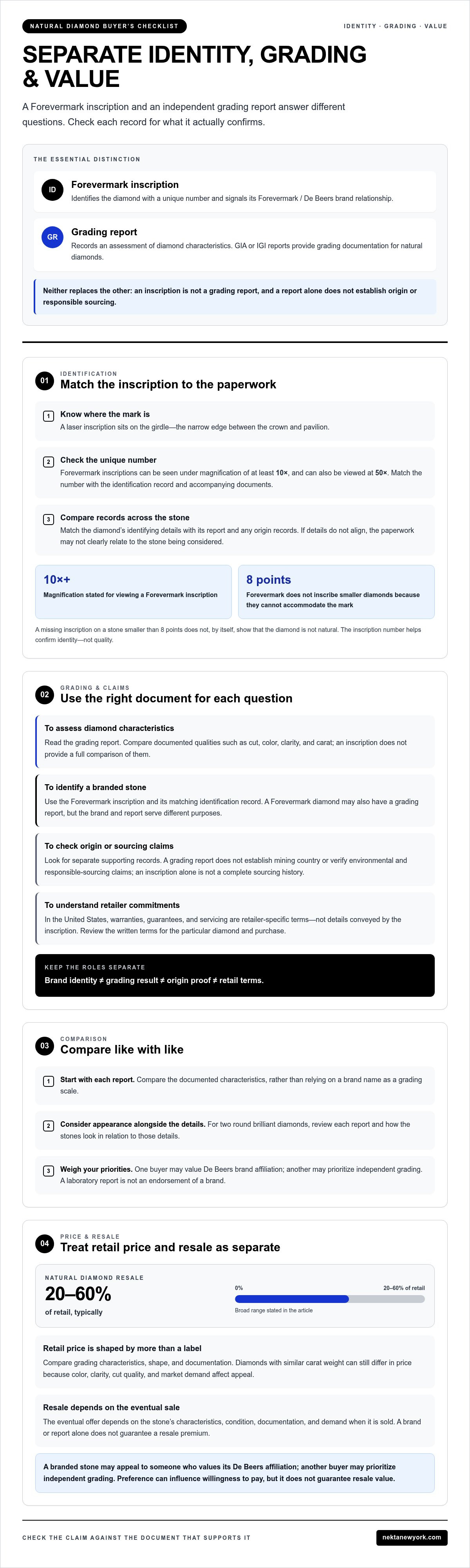
A GIA report assesses a diamond’s characteristics, while a Forevermark inscription is a separate identifying mark. Neither replaces the other. If a natural diamond has both, compare the report’s identifying details with the inscription and accompanying documentation. This distinguishes the stone’s recorded grading from its brand identity. It also keeps origin and responsible sourcing in perspective: an inscription alone is not a complete sourcing history.
Laser Inscription and Registration
A laser inscription places a small identifying mark on the diamond’s girdle, the narrow edge between its crown and pavilion. Forevermark inscriptions can be seen under magnification of at least ten times, and they can also be viewed under 50 times magnification. The mark includes a unique identification number. Match that number with the diamond’s accompanying identification record and documentation; the number helps confirm identity, not quality.
Forevermark doesn’t inscribe diamonds smaller than 8 points because they can’t accommodate the inscription. A missing inscription on a smaller stone therefore doesn’t, by itself, show that the diamond is not natural. For a stone that carries a mark, inspect the number under magnification and compare it with the paperwork before relying on the identification.
Forevermark Selection Criteria
Forevermark states that it selects natural, mined diamonds and excludes laboratory-grown diamonds. This addresses basic origin, but the inscription is not a detailed grading report. To assess a diamond’s quality, read its report and consider how the recorded characteristics align with your priorities. This separates program eligibility from the grading of an individual stone.
In the United States, warranties, guarantees, and servicing are retailer-specific terms, not details conveyed by an inscription. Read the written terms for the particular diamond and purchase. Keep those documents with the grading report and identification record, so brand identification, quality information, and retail commitments remain distinct.
Comparison with independent laboratory grading reports
The De Beers Forevermark vs. independent GIA-certified natural diamonds comparison comes down to two distinct roles: brand identity and laboratory grading. The main risks are treating a brand as a grading result or assuming a grading report establishes a diamond’s origin. Evaluate each claim against the documentation that supports it.
Independent Laboratory Grading Reports
An independent laboratory grading report records an assessment of a diamond’s characteristics, separate from a brand program. For natural diamonds, GIA or IGI reports provide grading documentation; a Forevermark inscription replaces neither. Read the report for the stone’s assessed qualities, but don’t treat it as proof of responsible sourcing, environmental practices, or a particular mining origin. Those claims require separate supporting records.
Branding and Grading Differences
Forevermark identifies a relationship with the De Beers brand, while GIA provides independent laboratory grading. A Forevermark diamond may also have a grading report, but the brand and report answer different questions. The inscription does not provide a full comparison of cut, color, clarity, and carat. For a meaningful assessment, match the stone to its report and compare the documented characteristics.
For example, when comparing two round brilliant diamonds, review the details in each report and consider how the stones look alongside those details. A familiar brand name isn’t a grading scale, and a laboratory report isn’t an endorsement of a brand. The De Beers Forevermark vs. independent GIA-certified natural diamonds decision becomes clearer when you weigh the records separately.
Buyer Risks and Origin Claims
Risk arises when branding, grading, and origin claims are treated as interchangeable. A report describes assessed diamond qualities; it doesn’t establish the mining country or verify environmental and responsible-sourcing claims on its own. Likewise, a Forevermark name alone doesn’t show every detail of a stone’s provenance. Match each claim to the documentation that addresses it.
Compare the identifying details across the diamond, its report, and any origin records. If they don’t align, the paperwork may not clearly relate to the stone being considered. For a closer look at independently graded diamond choices, use the report and identifying information together rather than relying on branding alone.
Diamond prices and resale value
A Forevermark name and a GIA report can influence how a diamond is presented, but neither alone sets its price. Compare the stone’s grading characteristics, shape, and documentation alongside its brand relationship. Two natural diamonds with similar carat weight can still differ in price because color, clarity, cut quality, and market demand affect their appeal.
For a fair comparison, match like with like. Review each diamond’s report, then compare its recorded characteristics and overall appearance. A branded stone may appeal to a buyer who values its De Beers affiliation, while another may prioritize independent grading over brand identity. That preference can influence what someone is willing to pay, but it doesn’t guarantee a resale premium.
Resale is a separate calculation from retail price. Natural diamonds typically resell at 20 to 60 percent of retail. The eventual offer depends on factors such as the stone’s characteristics, condition, documentation, and demand when it is sold. Treat that range as a broad market pattern, not an estimate for a particular Forevermark or GIA-graded diamond.
A responsible purchase also means understanding what the paperwork supports. A grading report documents assessed qualities; it does not promise future value or prove a specific origin. Sourcing records and brand documentation may provide separate provenance information. Keep those records with the grading report, since complete paperwork can help identify the diamond during a later valuation.
Before choosing, decide what matters most: a particular look, documented grading, brand association, or potential resale. Then compare the diamonds’ reports and characteristics rather than relying on a label alone. If two stones meet your grading priorities, for example, the distinction between Forevermark branding and independent GIA assessment may guide your preference, but neither guarantees a higher selling price later.
Forevermark's relationship to De Beers
De Beers launched the Forevermark diamond programme in 2008. That launch positioned Forevermark as a branded diamond programme connected with De Beers. It didn’t make Forevermark an independent grading laboratory. A GIA report represents laboratory grading, while Forevermark identifies a brand relationship. These roles can coexist on one natural diamond, but answer different questions. One concerns programme affiliation; the other records assessed diamond characteristics.
De Beers’ ownership gives further context to the Forevermark name. Anglo American plc has owned 85 per cent of De Beers since 2011, as part of a joint venture. The Government of the Republic of Botswana has owned 15 per cent since 2011. Those figures describe De Beers ownership, not an individual diamond’s grade or origin. Keep corporate ownership distinct from the records attached to a particular stone.
Forevermark diamonds are sourced from countries including South Africa, Botswana, Namibia, and Canada. Those locations describe sourcing countries, not the precise origin of every diamond. A country list doesn’t identify a specific stone’s mine, route, or chain of custody. The Kimberley Process Certification Scheme was established in 2003 as a separate industry process. Don’t treat that scheme, a Forevermark mark, and a grading report as interchangeable evidence.
When reviewing De Beers branding, separate three questions: who stands behind the programme, what the grading report records, and what documentation says about sourcing. Read the report for its assessment, then consider what accompanying records establish about origin. This keeps brand prestige from substituting for grading or provenance evidence. Weigh De Beers affiliation against your preference for independent grading before deciding what matters most. Review diamond choices with those distinctions in mind.
Mike Nekta New York: Round Brilliant Cut Engagement Rings
Mike Nekta New York offers Round Brilliant Cut Engagement Rings for readers ready to turn diamond research into a considered ring choice. Once you’ve weighed brand identity against independent grading, focus on the diamond’s documented characteristics and the shape that suits your preferences. A report helps you assess the stone, while the setting and cut shape its appearance as a finished ring.
Explore Round Brilliant, Cushion, Oval, and Emerald Cut Engagement Rings to compare distinct silhouettes. A round brilliant has a classic outline, while cushion, oval, and emerald cuts each create a different visual character. Let your priorities guide the choice, from the diamond’s profile to how its grading details align with your preferences.
As a next step, bring your preferred shape and grading priorities into the conversation. Contact Mike Nekta New York to discuss engagement ring options.
Choose the Diamond That Feels Right for You
Your next step is to turn your priorities into a personal design choice. Comparing De Beers Forevermark and independently GIA-certified natural diamonds can clarify what matters to you, but the ring should also reflect the person who will wear it. Consider which silhouette feels right and how you want the diamond to look in everyday life.
Mike Nekta New York offers Round Brilliant Cut, Cushion Cut, and Oval Cut Engagement Rings. Each shape has a distinct character, giving you room to choose a style that feels considered rather than dictated by a label. Let your preferences guide the conversation, then make your choice with care.
Contact Mike Nekta New York to discuss engagement ring options. Your next step can be thoughtful, personal, and entirely your own.
Frequently Asked Questions
Conclusion: Which Diamond Is Right for You?
Choose the diamond whose documentation, appearance, and brand association best match your priorities. If you value a De Beers program identity, consider Forevermark; if independent grading is central, compare natural diamonds with GIA reports. Someone choosing a round brilliant engagement ring, for example, may prioritize its visual character alongside the report, while another buyer may place greater weight on brand affiliation.
Does GIA certify diamonds or grade them, and what does a GIA report include?
GIA grades diamonds and issues grading reports. “GIA certified” is common retail phrasing, but a report is not a warranty or guarantee. A natural-diamond report records assessed characteristics such as carat weight, color, clarity, and cut information where applicable. Use the report’s identifying details to match it to the stone, then read its findings as a professional assessment, not a promise about future value.
How do Forevermark and GIA-certified diamonds compare in cut, color, clarity, and carat grading?
Compare the individual diamond’s documented characteristics, not just its Forevermark or GIA label. GIA reporting assesses diamond qualities, while Forevermark branding identifies a relationship with the De Beers program; the brand name alone does not provide a side-by-side grading comparison. For a round brilliant, examine the cut information along with color, clarity, and carat weight. For other shapes, compare the report details with the stone’s appearance.
Are Forevermark diamonds independently graded by GIA or another gemological laboratory?
A Forevermark inscription alone does not establish that a diamond has a GIA report or a report from another independent laboratory. Some Forevermark diamonds have accompanying grading reports, but the issuing organization determines who performed the assessment. To distinguish the documents, look for the laboratory name and report identification, then match those details to the diamond. The brand inscription and laboratory assessment serve separate purposes.
What is the price premium for Forevermark diamonds compared with similar GIA-graded natural diamonds?
There is no fixed premium that applies to every Forevermark diamond. For a meaningful comparison, match natural stones by grading characteristics, shape, and overall appearance, then consider whether the buyer values the Forevermark brand association. Differences in cut quality, color, clarity, carat weight, and documentation can affect pricing, so a brand label alone cannot explain the price gap between unlike diamonds.
How do Forevermark and GIA-certified diamonds compare in resale value and buyback policies?
Neither a Forevermark inscription nor a GIA report creates a buyback policy or guarantees a resale offer on its own. Resale terms depend on the seller or buyer involved, so read any written buyback or trade-in conditions separately from the diamond’s grading paperwork. Before purchasing, keep the original report, identifying records, and transaction documents together. These details can help a future evaluator identify and assess the stone.